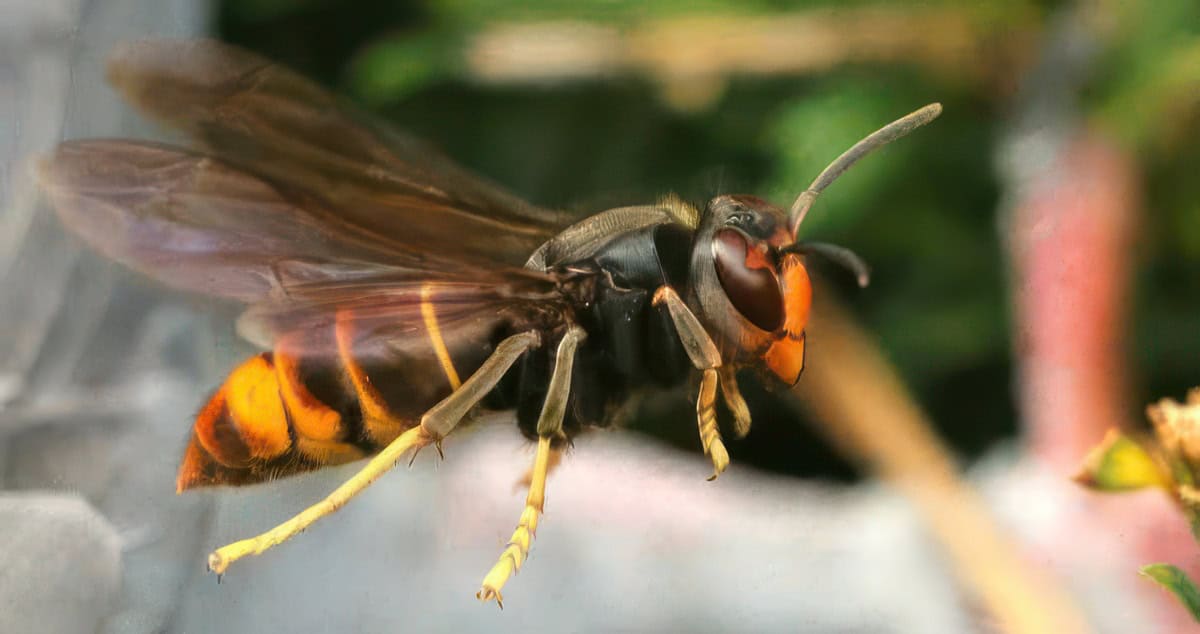
A single Yellow-legged Asian hornet spotted by an Islander and reported through the Asian Hornet Watch app has led to the successful location of the first Yellow-legged Asian hornet nest found on the Isle of Wight.
The nest was located by the National Bee Unit (NBU) on Monday 7th September, following a carefully coordinated tracking operation, assisted by members of the Isle of Wight Asian Hornet Team.
How the nest was tracked down
The search began after a member of the public spotted a Yellow-legged Asian hornet, took a photograph and submitted the sighting through the Asian Hornet Watch app. That one report provided the vital evidence needed for the sighting to be investigated.
Working together, the National Bee Unit and members of the Isle of Wight Asian Hornet Team established and monitored bait stations to attract foraging hornets. Once regular activity had been confirmed, radio trackers were attached to individual hornets, allowing their movements to be followed as they returned towards their nest.

The time-consuming work paid off when the nest was successfully located high in an oak tree.
The nest will now be destroyed by the National Bee Unit and analysed over the coming days. This will provide valuable information about the colony, including its stage of development and whether it had begun producing new queens.
The Isle of Wight Asian Hornet Team would like to thank the National Bee Unit for its expertise and determination, together with everyone who assisted with the successful search. Particular thanks go to the Islander who took the time to photograph and report the original hornet through the Asian Hornet Watch app.
One person saw one hornet, took a photograph and reported it – and that report ultimately led to the first nest on the Island being found.
Why early detection matters
Although finding the nest is a very positive outcome, it is important that Islanders remain vigilant.
The nest had gone unnoticed for much of the summer, demonstrating how easily a Yellow-legged Asian hornet colony can develop without being detected. If a nest reaches the reproductive stage, it can produce numerous new queens. Those that successfully mate and survive hibernation have the potential to establish new nests the following spring.
Early detection is therefore crucial. Yellow-legged Asian hornets are highly effective predators of insects, including honey bees and other pollinators. If allowed to establish on the Isle of Wight, they could pose a significant threat to the Island’s beekeeping community and wider biodiversity.
The Isle of Wight Asian Hornet Team was established to raise awareness across the Island so that people know what to look for and, importantly, what to do if they see one. The discovery of this first nest demonstrates just how valuable public awareness can be.
How to report a sighting
We are asking everyone on the Isle of Wight to keep looking.
If you see an insect you think could be a Yellow-legged Asian hornet, try to take a photograph and report it using the Asian Hornet Watch app.
Don’t worry if the photograph isn’t perfect – a blurry photograph is better than no photograph at all. Even an imperfect image may provide the evidence needed for a sighting to be investigated.
Anyone who would like to help the Isle of Wight Asian Hornet Team with awareness and monitoring work across the Island can contact:
See it. Snap it. App it.
News shared by Christine on behalf of the Isle of Wight Asian Hornet Team. Ed