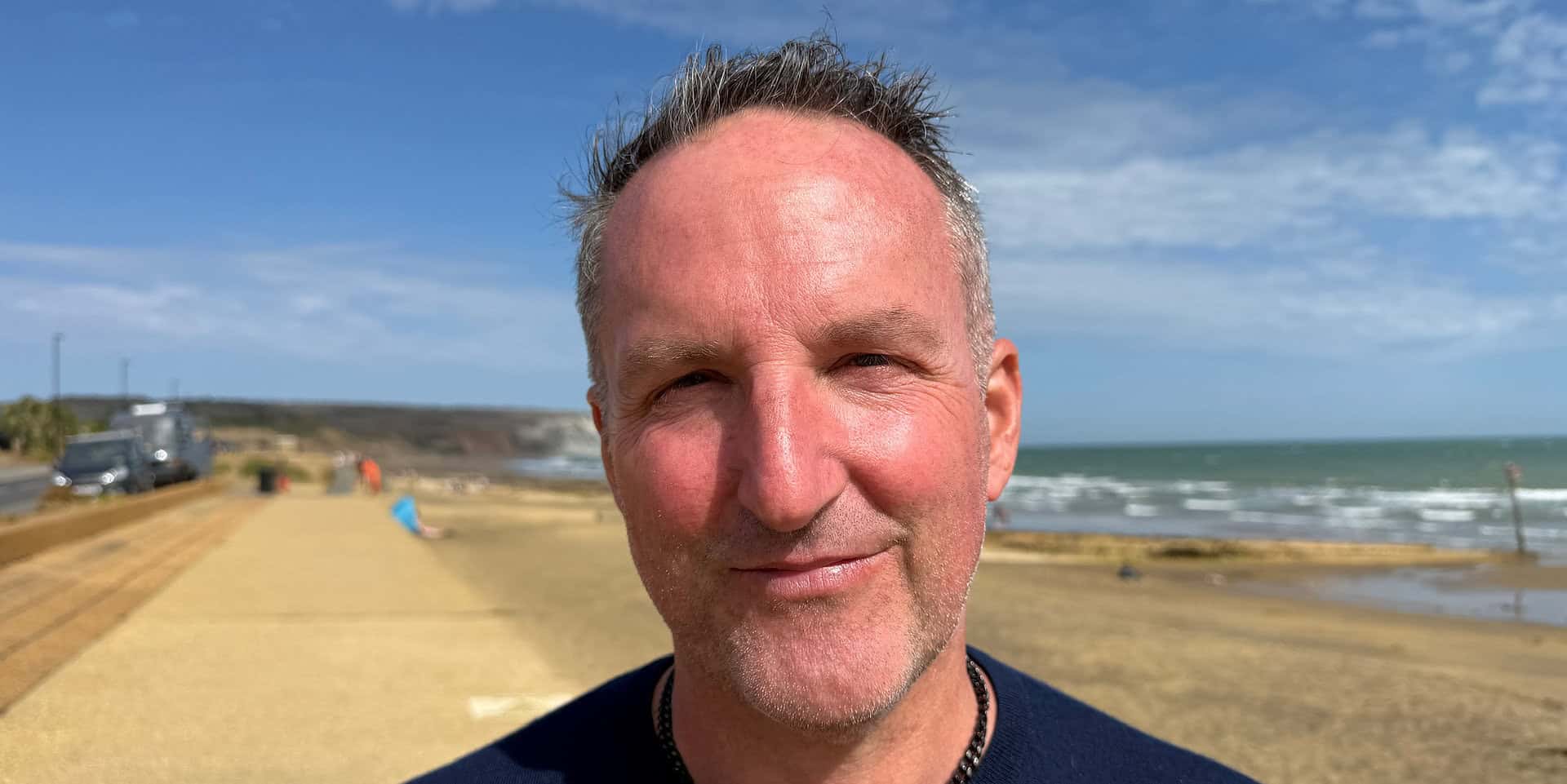
Last week, OnTheWight met with world renowned sculptor, Jason deCaires Taylor, to find out more about possible plans for intertidal sculptures on the beach in Sandown as part of the Town of Culture 2028 bid.
As previously reported, Sandown was one of 15 places shortlisted for a potential £3 million prize to become Town of Culture 2028.
Jason explained that he’s been in conversation for over a year with Artecology – a not-for-profit organisation based in Sandown that delivers nature inclusive design and eco engineering.
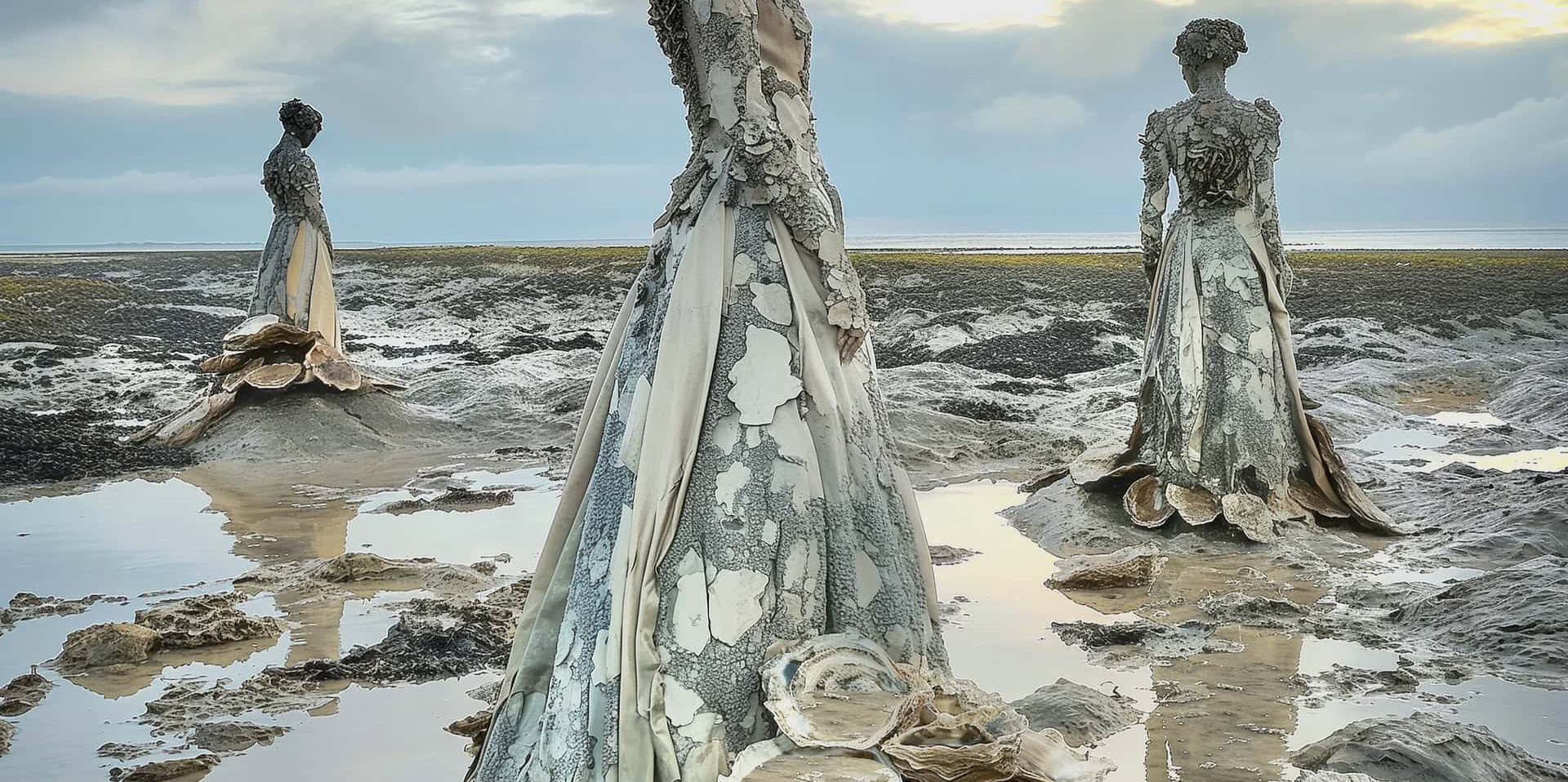
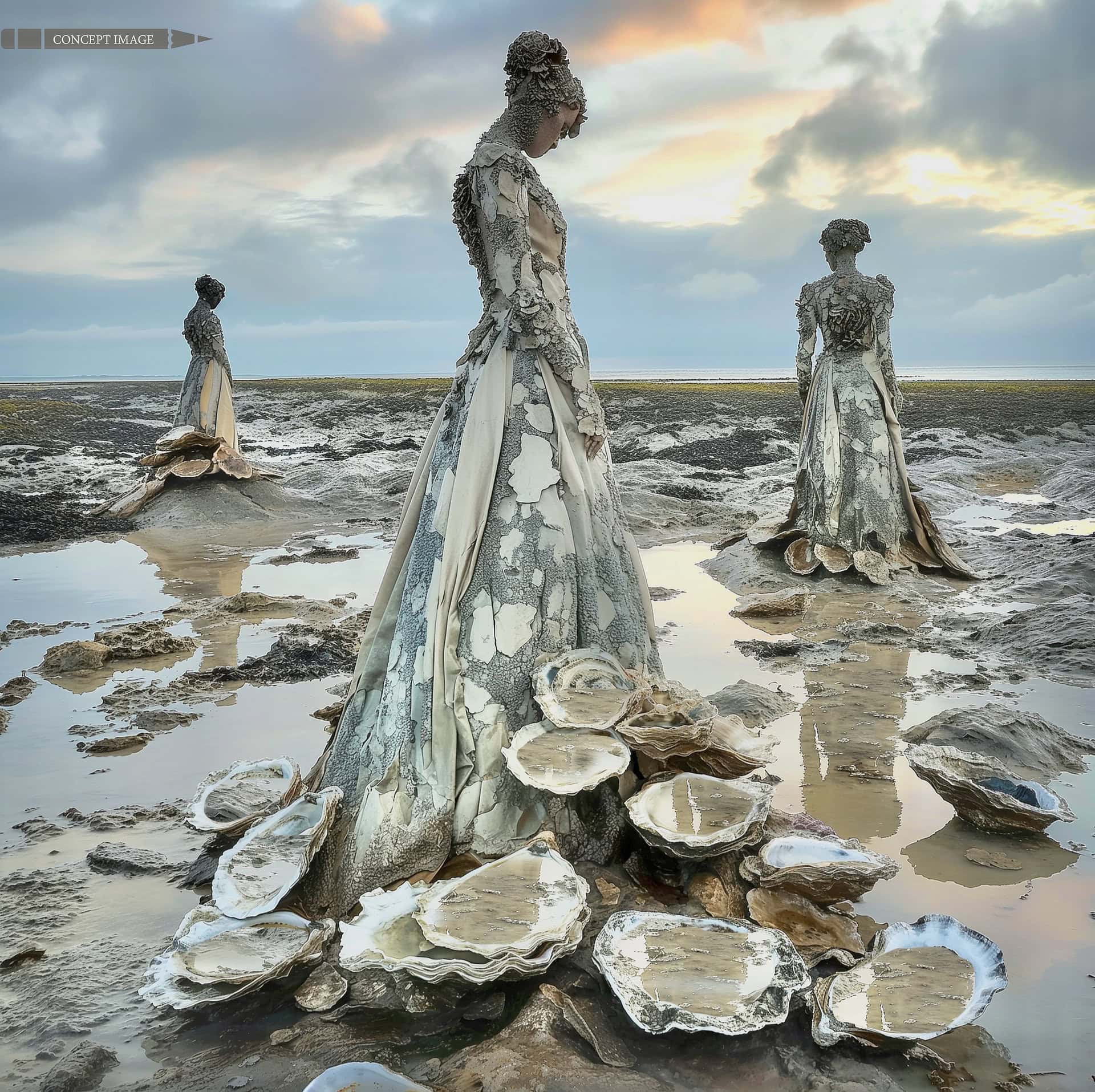
This week’s visit was a scoping exercise for Jason to explore a possible location for an intertidal sculpture series called Sandown Sirens.
Jason has already sketched out what the piece might be, and explained that the shape of it would hold seawater on the sand after the tide has gone out. He said,
“It would probably be a sculpture that retains the water within it.
“So we’re looking at sirens that have these dresses that have all these tidal pools within the dress.
“So even at low tide, it will still keep the water in and still create these rock pools and areas of habitat.”
Two decades of building reefs that look like people
Jason deCaires Taylor has spent his career putting figurative work into the sea rather than on land. He explained,
“I’m a sculptor, obviously from the UK, and I’ve spent the last 30 years specialising in making sculptures for marine environments, and I’ve worked across the world from the Caribbean to the Indian Ocean to the Pacific Ocean in Australia and the Maldives and Mediterranean.”
The pieces are artificial reefs as much as they are artworks.
“They’re designed to aggregate marine life, to draw tourists away from fragile areas and congregate them around these sites underwater.”
Jason told OnTheWight the gap in his own portfolio bothered him. He said,
“There’s a part of me that feels quite sad that I actually haven’t produced many works in my own home country, here in the British Isles, and so I got in touch with Nigel.”
Water clarity in British waters rules out the fully submerged work he makes in the tropics, which is why the Sandown idea sits in the intertidal zone – intertidal meaning the works can be seen when submerged and out of the water. He said,
“One of the big problems in the British Isles is the water visibility isn’t like the Caribbean, but it still has some incredible marine life and it really is incredibly rich and diverse. More people should, I think, become aware of how fantastic the underwater world is here.”
Fifty tonnes of force from a single wave
Asked how a sculpture survives the sea off Sandown Bay, Jason went straight to the numbers,
“A huge part of the work is the engineering behind it, and all the works are planned for the most extreme weather, and a wave can place 50 tonnes of weight lateral force onto an object.”
That dictates the mass of the thing.
“The average weight for sculpture is probably like 10-15 tonnes, but I’ve done some which are 130 tonnes, and it’s more a logistical exercise than it is a romantic Michelangelo experience.”
The 130-tonne piece went into the Great Barrier Reef off Australia, and the paperwork took longer than the build. Jason explained,
“It took us five years to get the permit from the Great Barrier Reef Marine Park Authority, and it’s one of the only projects actually that was ever permitted along that coastline.”
Getting marine life to settle on the surfaces took years of trial and error.
“It’s taken a while to find exactly the right materials that have pH neutral surfaces, that are inert, that don’t corrode or break down or change properties over time.”
What 500 sculptures did to a sandy seabed
Jason’s largest installation sits off Mexico,
“I did a very big project in Mexico, which is around 500 sculptures on a sandy seabed.
“And now I go there, and there’s manta rays, turtles, thousands of corals, schools of fish, and it’s really humbling to see an area that was desolate before, how marine life gravitates towards these structures.”
A Sandown piece would target different species entirely, Jason explained,
“We would be looking at designing something bespoke for here that sits within this tidal zone that attracts mussels and oysters and has these rock pools that will hopefully attract a variety of life.”
He is also thinking about building monitoring kit into the sculpture, which is easier close to shore than out on a reef.
“Being so close to the shore allows you opportunity to actually have scientific monitoring devices within the piece.”
He has done it before, fitting a hydrophone into a Mexican sculpture to record the reef. Jason explained,
“It takes six months worth of data, and they can analyse the impact of engines from boats, but also how corals navigate by sound.”
Another of his intertidal works, in Australia, is powered by a solar array on the beach and changes colour with sea temperature. He said,
“If there’s prolonged high sea temperatures where corals can bleach, then the sculpture turns red and gives a sort of warning to the coastal town that corals are at risk.”
Casting local people rather than famous ones
The figures in his work are almost always residents of the place the sculpture goes. Jason said,
“I do a lot of traditional techniques where I life cast people from the place.
“So the sculptures in Mexico, for instance, they were all the local community that I made live casts of, and it was about this sort of community in defence of their coastline.
“It’s very important that the works aren’t about sort of celebrating famous people.”
He also runs sessions with schools, scanning or casting children.
The heavy structural work is beyond public involvement because of the welding and load requirements, but the habitat detailing is not, and he pointed at the Artecology Vertipool sitting behind him as the model. He said,
“What’s really interesting about the vertipools is that everybody can get involved in creating the habitat spaces inside, and I think that’s definitely something that we’ll be looking to integrate in this.”
Empty shops in Norway, a banknote in Grenada
Jason also made a temporary tidal piece outside Tate Britain, and when the festival ended it was lifted out and shipped to an industrial town on the Norwegian coast. He explained the impact this had on the town,
“The town became so popular that cruise ships started organising tours there.
“A lot of shops were empty, a lot of businesses were struggling, and since then they’ve all reported a huge increase in traffic and visitors going for day trips there.”
His first project, in Grenada, went further. He said,
“I did a pilot project with the government there, and I’ve sort of self-funded it, but now it’s like the most recognised tourist attraction in the whole country.
“It’s one of the banknotes of the currency.”
He reached for Antony Gormley as the domestic parallel.
“He did the Angel of the North, which when he first started was hugely problematic, and nobody wanted it.
“There were lots of reasons why it would impact bird life and cause motorists to crash and all this stuff.”
He said Gormley’s beach figures met the same resistance over swimmer safety, boats and seabirds, and were installed on a six-month temporary permit.
“After the six months were up, he went to take them out, and the community were in uproar, and they were like, ‘No way! The hotel bookings have quadrupled. It’s brought back the sort of mojo to the town.'”
Three authorities for one sculpture on the Thames
Who owns the seabed off Sandown, and who grants permission to build on it is an important question. Jason explained,
“The British Isles in general is quite complex, the planning regulations.
“So we’ll be working through all the different agencies that will need to be involved in that.”
The Tate Britain piece gave him a taste of it. He said,
“The River Thames at low tide it was Lambeth Council at high tide it was Westminster Council, and it was also within the remit of the London Port Authority.
“So there was three entities that we had to work with to get the permitting.”
Asked about the groynes and the coastal defence work due at Sandown, he said the sculpture would go onto something already built rather than into the seabed.
“So we won’t be interfering with any of the natural substrates.
“We’ll be attaching it to something that’s existing.”
He swam the site during his visit, and said the weather did him a favour.
“It’s actually good coming here when there’s quite strong winds because you don’t get lulled into a false sense of security that is going to be flat calm.
“You realise how robust it needs to be and how well engineered it would have to be to withstand the elements.”
Nature takes over once the sculpture goes in
His most recent installation went into the Solomon Islands, on an island lost to rising sea levels. Jason explained,
“A community that used to live on the island had to evacuate, and now the whole island’s underwater and it comes out at low tide, but most of the time it’s flooded.”
The figure is a young local woman, an activist, and the piece carries the date the island was first submerged and the date the community left. He said,
“And then it’s got the sort of projected sea level rises up to I think 2040.”
Listen to the interview
You can listen to the 28 minute conversation by clicking on the play button below. You can also pause the recording, jump back or forward.

Sandown’s bid to be Town of Culture 2028 has made the shortlist, and the Sirens are written into it.
They are in there as legacy, something left standing on the beach long after the title year has run out.
Visit Jason deCaires Taylor’s website for more information about the artist.