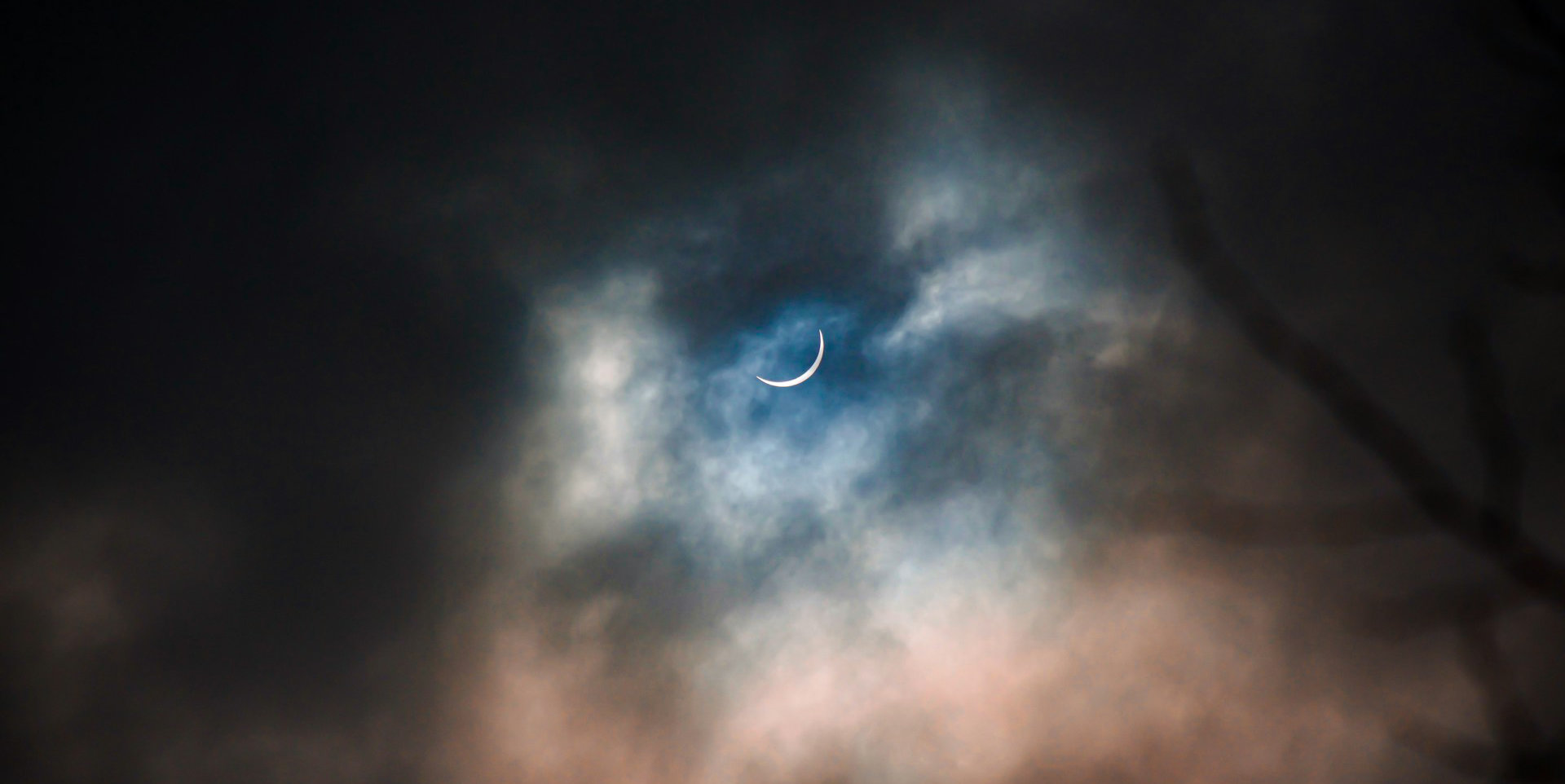
Unless you have been hiding under a rock, you’ll know that a deep partial solar eclipse will cross Isle of Wight skies on Wednesday 12th August 2026, beginning at about 6.18pm and ending shortly after 8.07pm.
Avoid looking directly at the sun
If you want to protect your vision, it’s vital you avoid looking directly at the sun during the eclipse.
A range of methods are listed below.
The Island sits outside the path
The sun will not disappear completely from here, and the last of the crescent will slide towards the horizon with the Moon still moving off it.
Weather permitting, the spectacle should be a striking one.
How it compares with 1999
Many Island residents still measure eclipses against August 1999, when totality crossed a narrow corridor through Cornwall and Devon during the morning and nearby Southampton recorded a magnitude of 0.986.
Wednesday’s event arrives at the opposite end of the day.
By final contact at 8.07pm the sun sits only a few degrees above the horizon, which David Grannum, founder of IsleConnect and Vectis ONE, says changes what you need from a viewing spot entirely.
He added,
“This is not totality, but it should still be an extraordinary Island evening.
“The important thing is to choose the right horizon, use proper eye protection and treat the event as a chance to look up and experience the place together.”
Where to watch
David Grannum has provided a list of potential viewing spots across the Island.
Players Beach in Ryde give flat, accessible ground with transport and town centre links close by, and they work well for the opening and maximum phases.
But the low sun tracks across land towards Quarr, Fishbourne and East Cowes as the eclipse ends, so trees, buildings, haze or the headland may intervene.
Gurnard Esplanade carries more urban light and likely pressure on parking, and suits the eclipse better than it suits later meteor watching.
Culver Down, Ryde and Appley serve East Wight residents and show the opening and maximum phases, though the Island landmass and local skyline clip the lowest west-north-west horizon.
Totland Bay and Colwell Bay offer direct western and west-north-west sea views from level promenades, under the darker West Wight skies that also favour the Perseids later.
Allow travel time and check parking, tides and local access arrangements before setting off.
Tennyson Down gives the most dramatic view of the lot, elevated over the Needles with an open marine horizon and a dark western sky, and it is also exposed, uneven and edged with unfenced cliffs that can turn dangerous after dark.
Mottistone Down opens onto a high, broad panorama with very dark skies and no immediate sea cliff edge at the main downland viewing area, though the tracks are uneven and unlit and the walk back needs proper footwear and a torch.
Chale Bay and the Military Road face a south-western marine horizon with little light pollution, but the cliffs there are actively eroding, so use the designated, set-back viewpoints and stay away from soft edges.
Watching without looking
A pinhole projector, a cereal box viewer or a colander held to cast dozens of small crescents onto a light surface all show the eclipse safely.
Stand with your back to the sun whenever you use projection.
Children need close supervision throughout, and adults should explain and check their equipment before the event begins rather than during it.
Alternatively use genuine eclipse glasses or a handheld solar viewer marked as complying with ISO 12312-2:2015(E).
A second event the same night
The Perseid meteor shower reaches its annual peak later on Wednesday night (12th August 2026).
A new Moon leaves the sky dark, so conditions should favour meteor watching once full darkness arrives, particularly from the West Wight sites.
Anyone staying out after dark would be wise to prepare for lower temperatures, uneven ground and limited lighting.
If you want to know more, the BBC has a comprehensive guide to the partial solar eclipse.