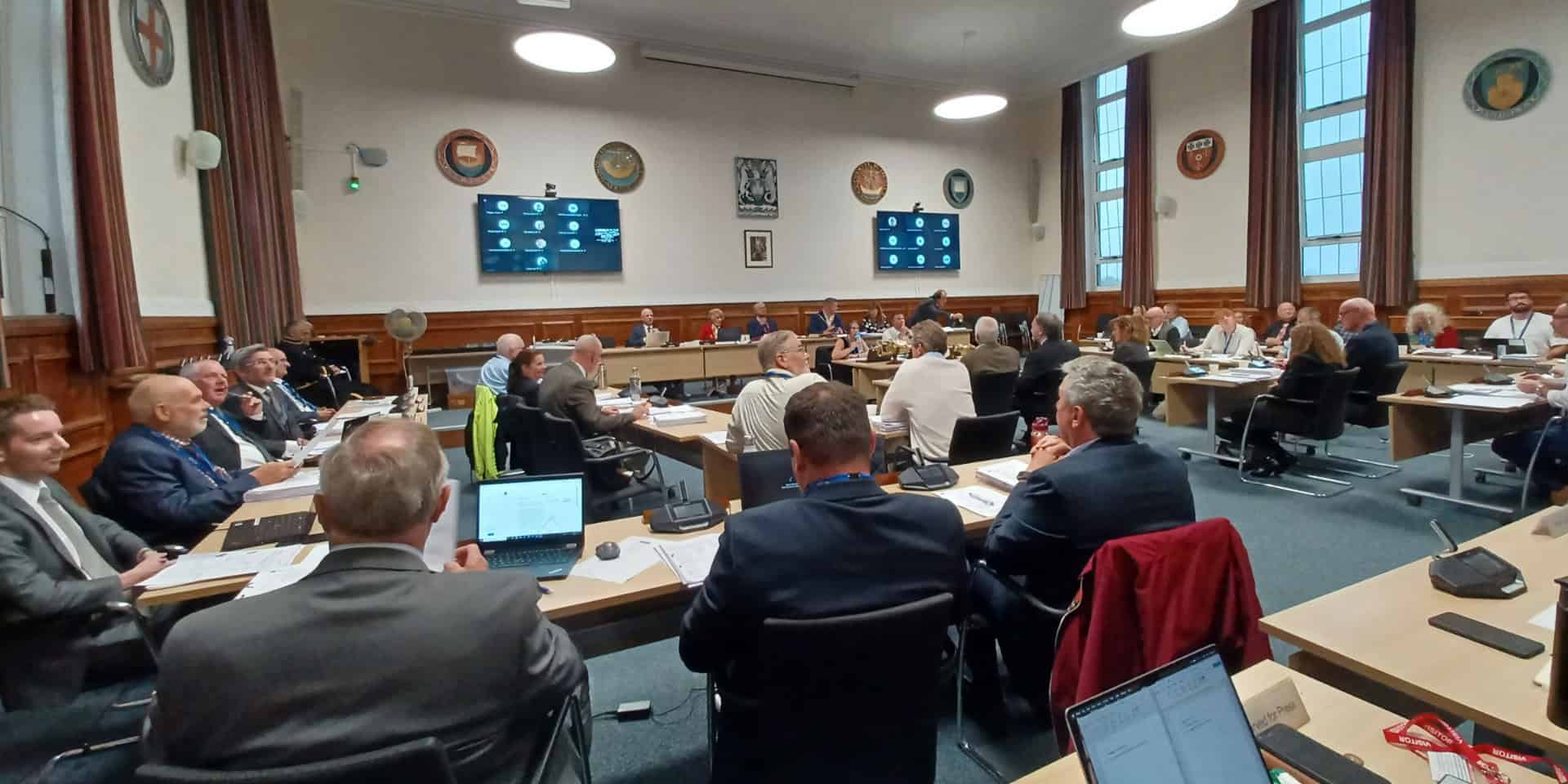
A proposal setting out a root and branch overhaul of local government across Hampshire and the Isle of Wight has been rejected by County Hall Wednesday evening (17th September 2025).
Full council voted against a landmark vision for local government reorganisation (LGR) put forward by 12 councils across the region: ‘Close enough to be local, big enough to stay strong’.
The chamber was sharply divided, with 15 in favour and 19 against.
Four new Mainland councils … and IW
A model of five unitary authorities was put forward: four new mainland councils in place of 14 existing ones, and the Isle of Wight keeping its current position.
It was drawn up in light of far-reaching devolution and local government reorganisation plans unveiled by Whitehall in December last year.
Devolution and LGR
The reforms include two separate but related policy packages: shifting powers and funding from Whitehall to England’s regions by creating Strategic Authorities with elected mayors (Solent Devolution) and ending the two-tier system of county and district councils with new unitary authorities covering populations of at least 500,000 (LGR).
Annual savings of at least £63.9 million
In February, then Minister of State for Local Government and English Devolution Jim McMahon, invited LGR proposals from Hampshire and Solent councils.
The proposal rejected aimed to simplify local structures, improve coordination of services and deliver estimated annual savings of at least £63.9 million.
Maintaining the Isle of Wight as an independent or unitary authority
Section five of the document gives its case for the Island keeping its unitary authority,
“With a track record of financial sustainability and effective service delivery, the Isle of Wight Council has operated successfully as a unitary council since 1995.
“The Island’s unique geography, accessible only by ferry, creates distinct logistical and service delivery challenges that are best addressed through a locally focused model.
“Being an independent authority has enabled tailored responses to challenges, demographic pressures and environmental priorities while protecting the Island’s local identity.
“Maintaining the Isle of Wight as an independent or unitary authority will ensure it continues to respond to local needs while standing alongside new the mainland unitary councils through an enhanced partnership.”
You can watch the debate from Wednesday night’s meeting below.
This article is from the BBC’s LDRS (Local Democracy Reporter Service) scheme, which News OnTheWight is taking part in. Some alterations and additions may have been made by OnTheWight. Ed