Saturday afternoon at Quay Arts brought with it the opportunity to hear from and speak to the several artists involved with No Ordinary Town – the latest exhibition in the Clayden Gallery.
The exhibition is the culmination of a year-long programme of work spearheaded by Boojum&Snark‘s Creative Director, Tracy Mikich.
Listen to our conversation with writer Anmarie Bowler and artist Tommy Brentnall.

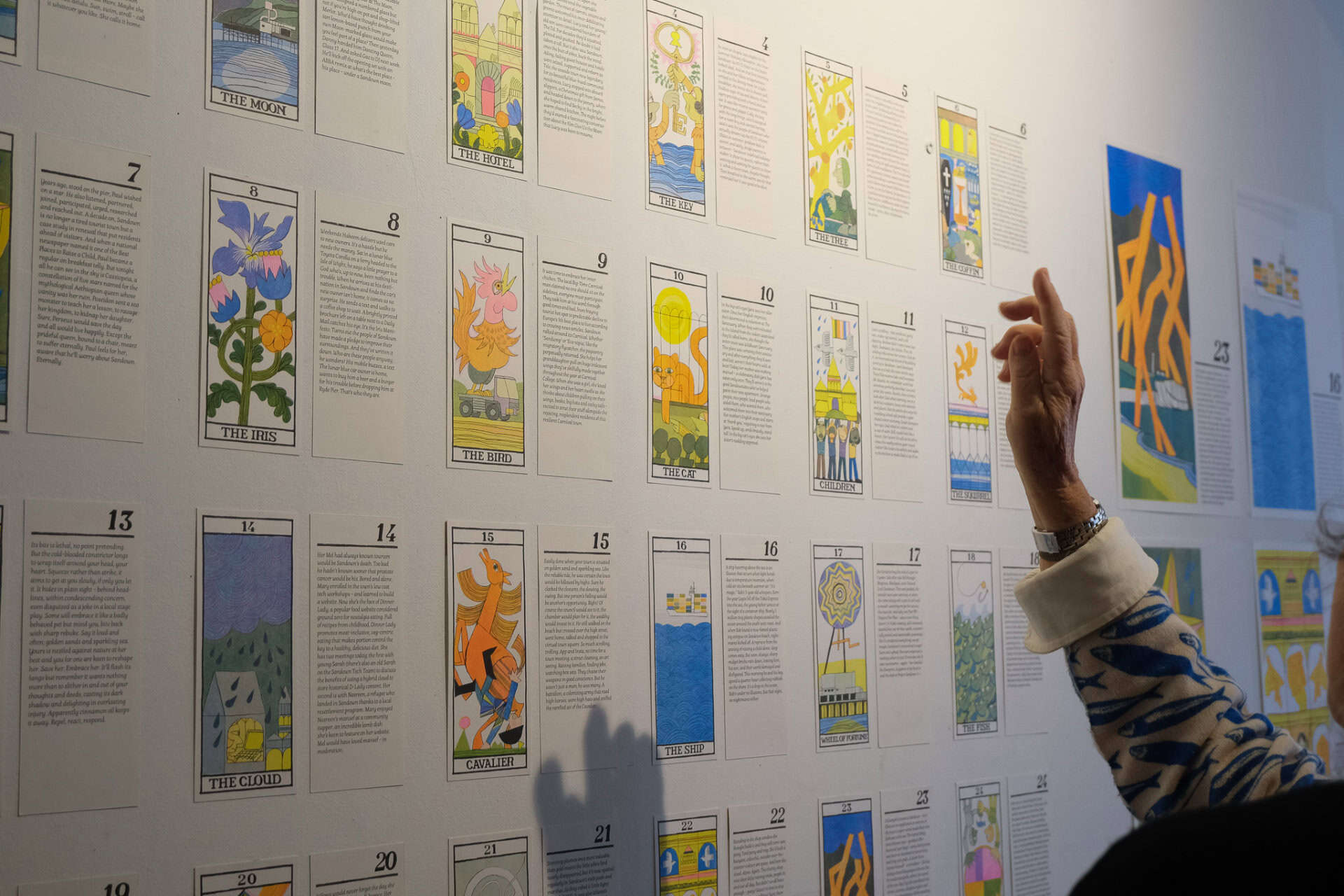
The exhibition is made up of many elements, including the award-winning Chuffle book, Sam the Sandown Clown (listen to our conversation with Teresa Grimaldi), the Sandown Survival residency and The Sandown Tarot.
A Tool for Survival
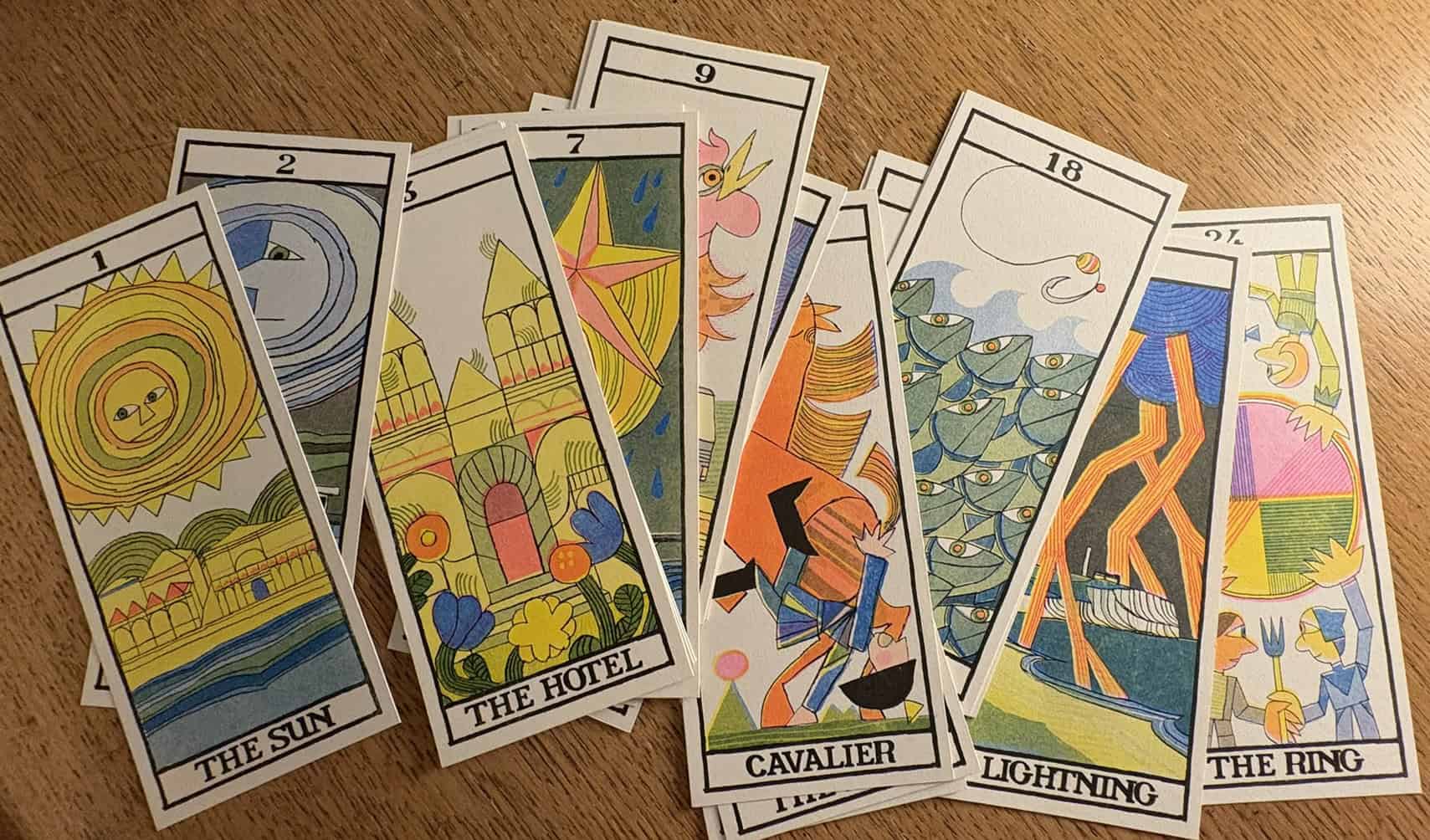
The Sandown Tarot, A Tool for Survival is a deck of 24 cards that “provide a compelling lens through which to explore Sandown and its future” and it was one of the final Sandown Rocks projects supported by Arts Council England.
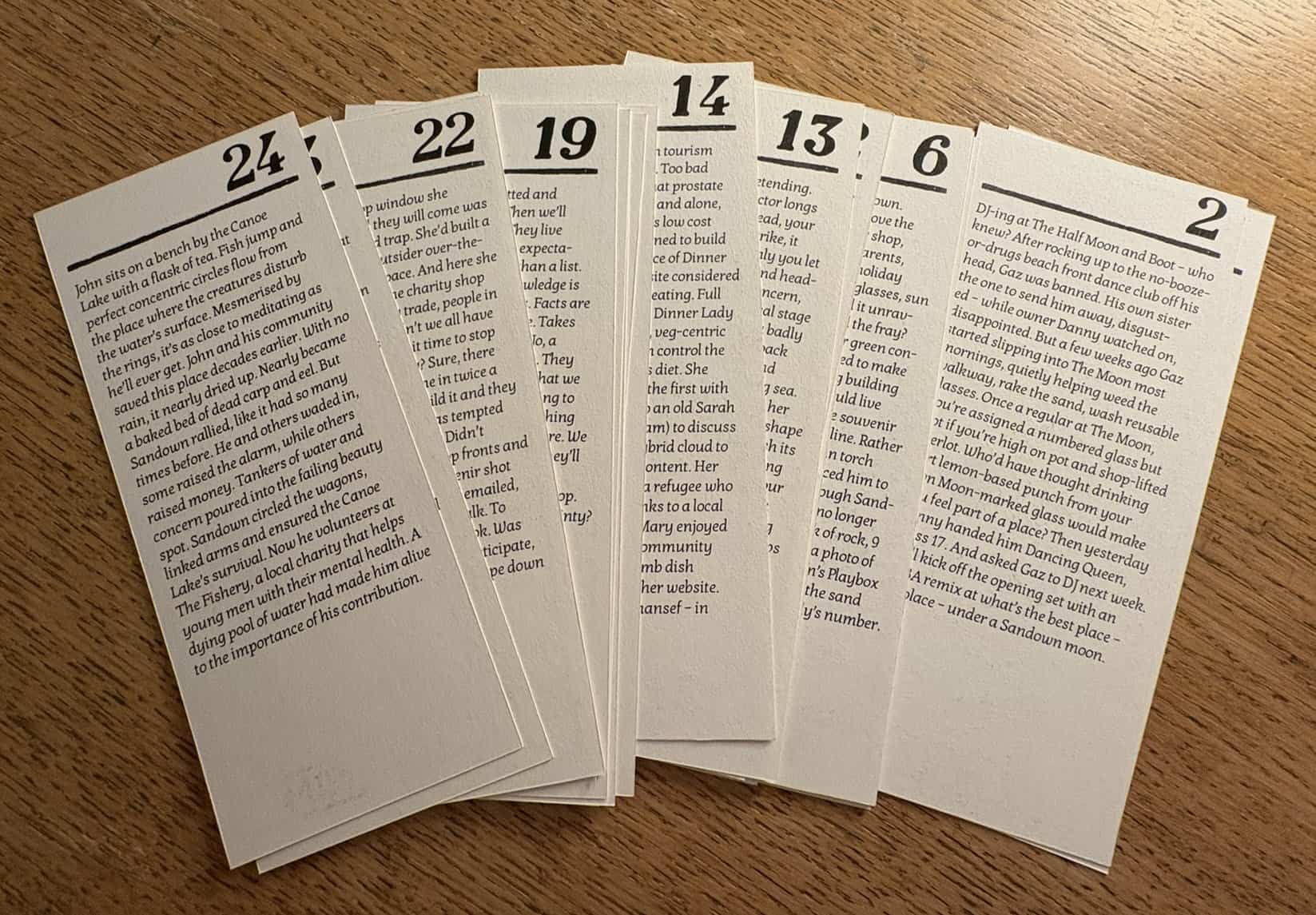
As you would expect from a deck of tarot cards, each is magnificently illustrated, but in a break from the norm, they all feature an original short story on the back of the card. Inspiration for both the writing and illustrations comes from the town, its people and its environment.
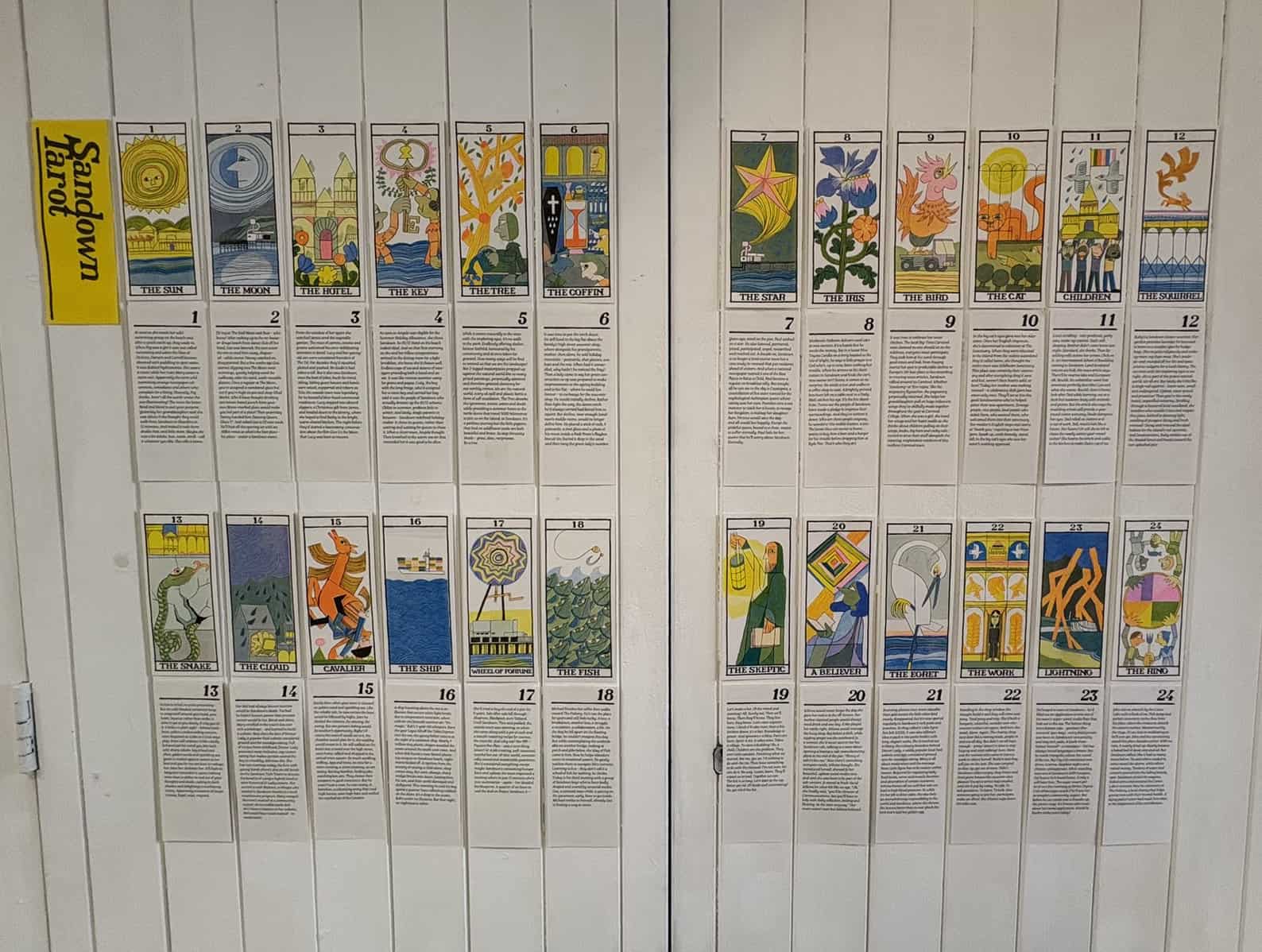
They’re incredibly touching and thought-provoking and we’d highly recommend a visit to the gallery to see in person (and you can even buy your own deck from the gift shop).
The creative process
As well as speaking with artist Teresa Grimaldi (more on that later) OnTheWight was lucky enough to catch some time with writer Anmarie Bowler and artist Tommy Brentnall, the two artists from different disciplines who collaborated on The Sandown Tarot project.
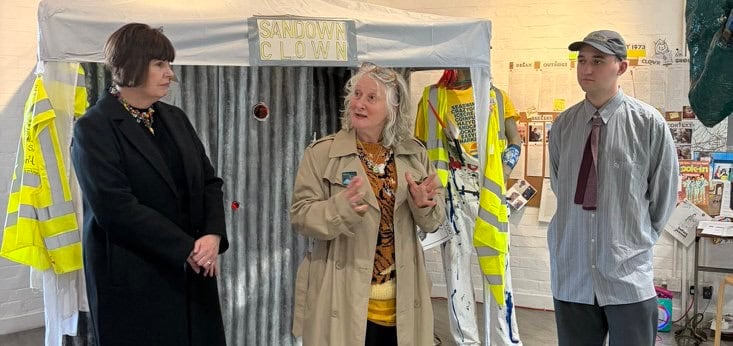
Anmarie explained the process the two of them used to create the deck of tarot cards,
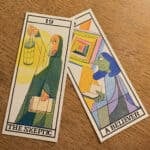
“They’re partly inspired by existing sets of tarot cards, the sun, the moon, things like that. Tommy was really good at taking certain ideas, like the man and the woman he changed to the sceptic and the believer. That was fantastic.
“I think Tommy and I had a great process, which sometimes the illustration came first, and I got a bit of inspiration from that. And sometimes it went the other way. Some things were obvious. It felt like Sandown was telling us what it wanted as well, which was exciting.”
Much to think about
Being able to work on something that embodies a strong visual set of images was the dream project for Tommy, who spent a month in residency at Boojum and Snark this summer. He shared why the work was so exciting to be involved with,
“You’re not drawing from nothing. There is a long-lasting iconography to work from, and a lot of existing symbolism that makes it really exciting to work with. So, as well as the material from the tarot card, I was also working with the stories that Anmarie was writing. There was so much to draw from.
“Sometimes you don’t have too much to work from, and that can be really stressful, whereas with this, there was so much to think about. It’s been fab.”
Bowler: This was right up my alley
Anmarie continued,
“We both spent quite a lot of time in Sandown. I live in Ryde and spend loads of time at Boojum, as does Tommy. So as we said, Sandown kept giving you ideas. I did a lot of research, reading newspaper articles, stuff from OnTheWight about Sandown, just to really feel what was going on and how the newspapers were talking about it, what people who lived in Sandown said, what kind of language they used, and then the stories, I mean, I’ve said it before, it was such a well conceived project.
“I don’t want to give away too much, but these stories just were easy to write and beautifully fun to write. So I loved it, there was so much inspiration there. You weren’t creating it from the whole cloth, there were illustrations, and then Sandown and what people say and stuff from the past, and these 150 word stories on the back of the cards just came. I’m a writer of short fiction, so this was right up my alley!”
The technical process
Tommy is highly experienced in risograph printing, which is the process that was used to create the tarot cards. He explained how the risograph printer works and how that informs his work,
“For anyone who doesn’t know, a risograph printer is a little bit like a halfway point between a photocopier and offset lithography. You’re printing one or two colours at a time in separations. Whereas normally, you make an illustration and then separate the image digitally into the various colour channels, these are printed in yellow, blue, black and fluorescent pink, to mimic traditional CMYK.
“But to make sure the colours really popped, I actually drew the images in separation. So I was working across three separate colour channels, drawing and overlaying as I was going, which was little complicated, but I think actually really allowed me to make sure that I want it to be, like 100% yellow here, and so it’s really drawing out the real core colours.”
A master of colour
Tommy talks with ease about the technical process of printing on the risograph printer, but it actually sounds quite complex.
For example, The Skeptic card shows a man wearing a cape of many shades of green. To achieve this with the limitation of four colours, Tommy has to know that he’ll create a certain section of the clothing as 40% blue and 60% yellow to achieve a limey green. Whereas to create a dusty green, he mixes 30% blue with 10% yellow.
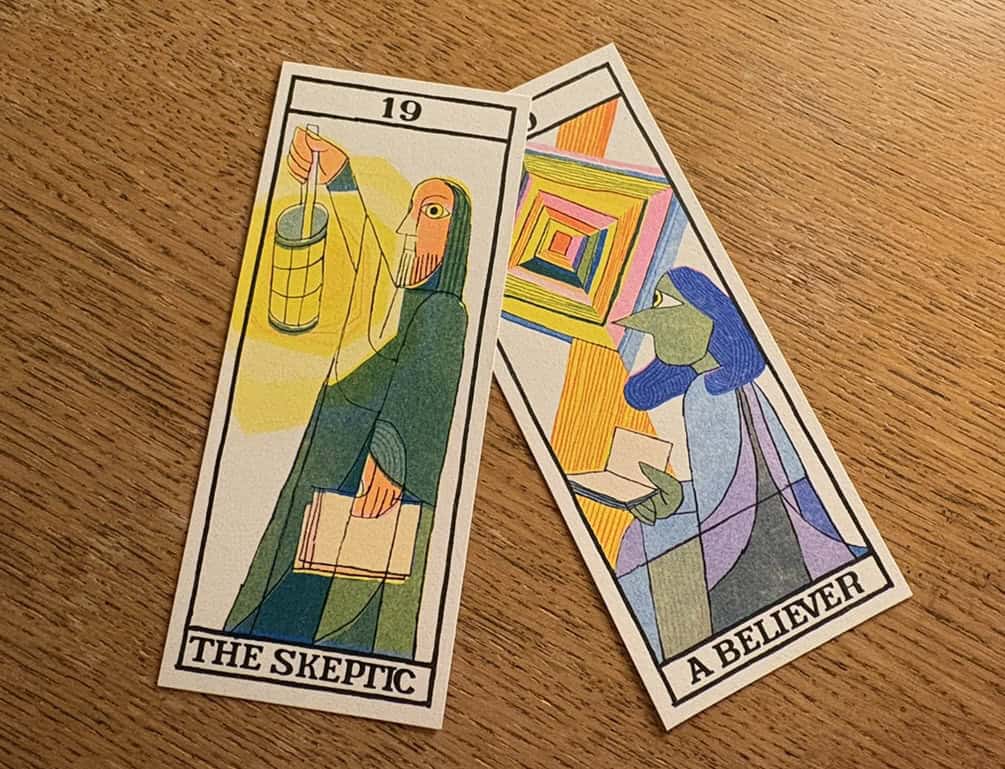
Obviously it takes a lot of experience of using the risograph printer to know exactly how to mix the colours correctly, because until you print you just don’t know how it will come out.
Inspiring colours
The colours used were something that also inspired Anmarie’s writing. She told us,
“Sandown sometimes gets a bad rap. But what Sandown always has, and you can never take it away, is sea and sand, and immediately you get some colours in your head. And that kept coming back to me about the way I felt about Sandown and the people that live there.
“Often we’d see a draft of something Tommy was doing and I thought, Oh yeah, I’m gonna have to say something in here about the blue sea or the dark sky or the moon and so, yeah, every point the the colours and illustrations were inspiring.”
Listen to our chat
You can listen to Simon chatting with Anmarie and Tommy by clicking on the play button below. You can pause, jump back 10 seconds, or jump forward 30 seconds. You can also leave it playing on the page whilst using other apps on your phone, or use other browser windows on your tablet or computer.
Buy your set
The Sandown Tarot cards are for sale in the Quay Arts shop for £18 each.
The exhibition runs until 29th November 2025, open daily from 10am-4pm in the Clayden Gallery.
Sandown Rocks is a year-long project supported by Arts Council England.
Find out more about Boojum and Snark by visiting their website.