What if we could all make a world of difference for wildlife with just the tips of our fingers?!
A research collaboration between eco-engineers Artecology and the University of Plymouth has confirmed just that, that hands-on community creativity – art, ecology and clay – can help transform futures for marine wildlife on our built and urbanised coastlines.
Award-winning Vertipools
Artecology is the design team behind the award-winning marine innovation, Vertipools, artificial rockpools for the marine environment, designing, manufacturing and exporting cutting edge ecological engineering from a studio in Sandown, Isle of Wight.
These hand-built concrete structures are installed on new or existing coastal infrastructure and have been inspiring, challenging and informing industry standards on how we make space for coastal wildlife in the face of rising sea levels and subsequent sea defences since 2013.
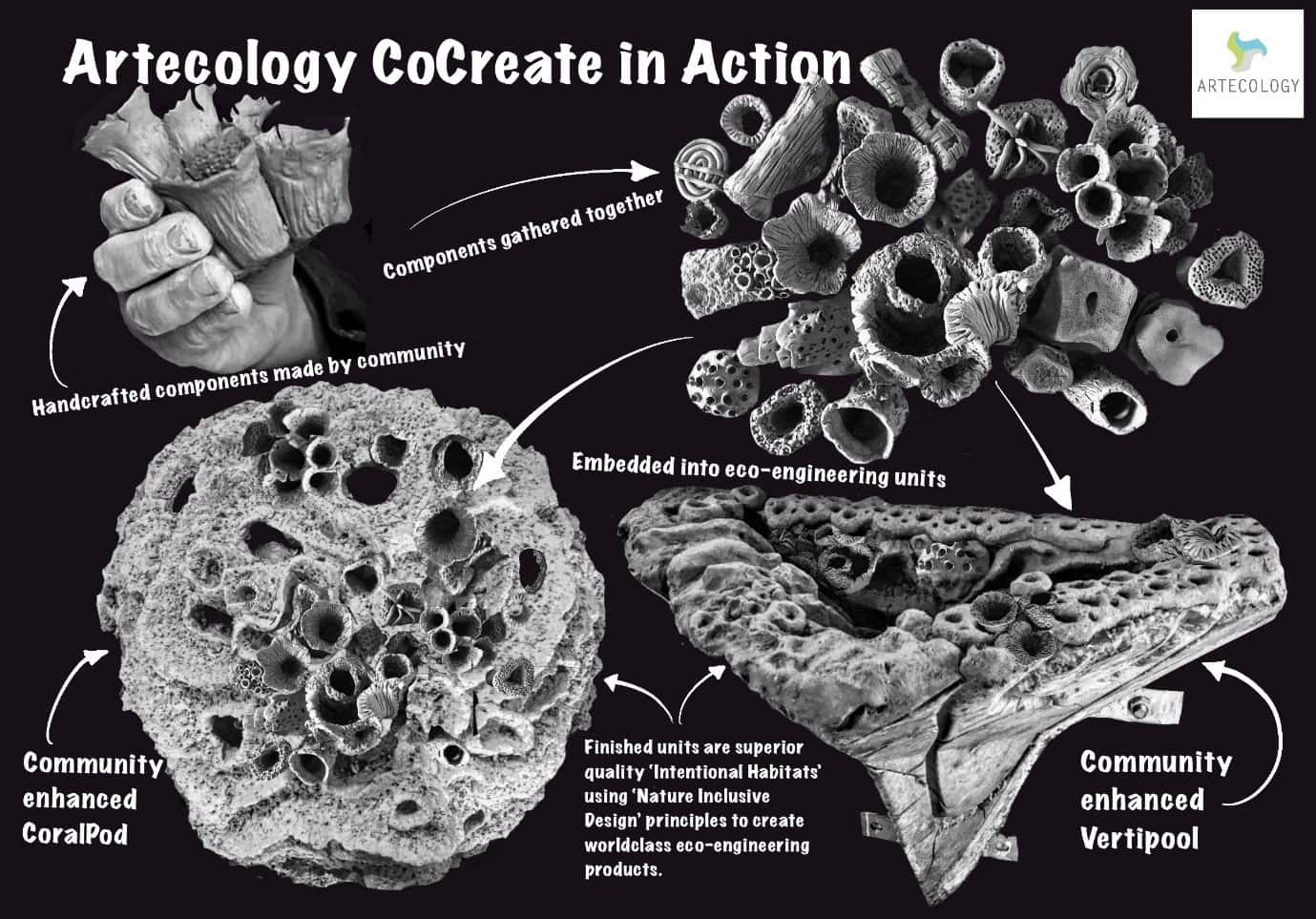
The global urbanisation of coastlines is a huge challenge for intertidal marine species, but Artecology is seeking to address this. Latest statistics have demonstrated that Vertipools can deliver a huge 247 per cent uplift for biodiversity in comparison a non-textured sterile sea wall*.
CoCreate
Most recently, Artecology’s team of artists and ecologists, have developed a method of production called CoCreate, where communities anywhere and everywhere can handmake detailed sculptures to be incorporated into the new ‘pool’ interiors of the Vertipools prior to deployment in their area. The ceramic inserts are made from hard-wearing grog clay and high-fired.
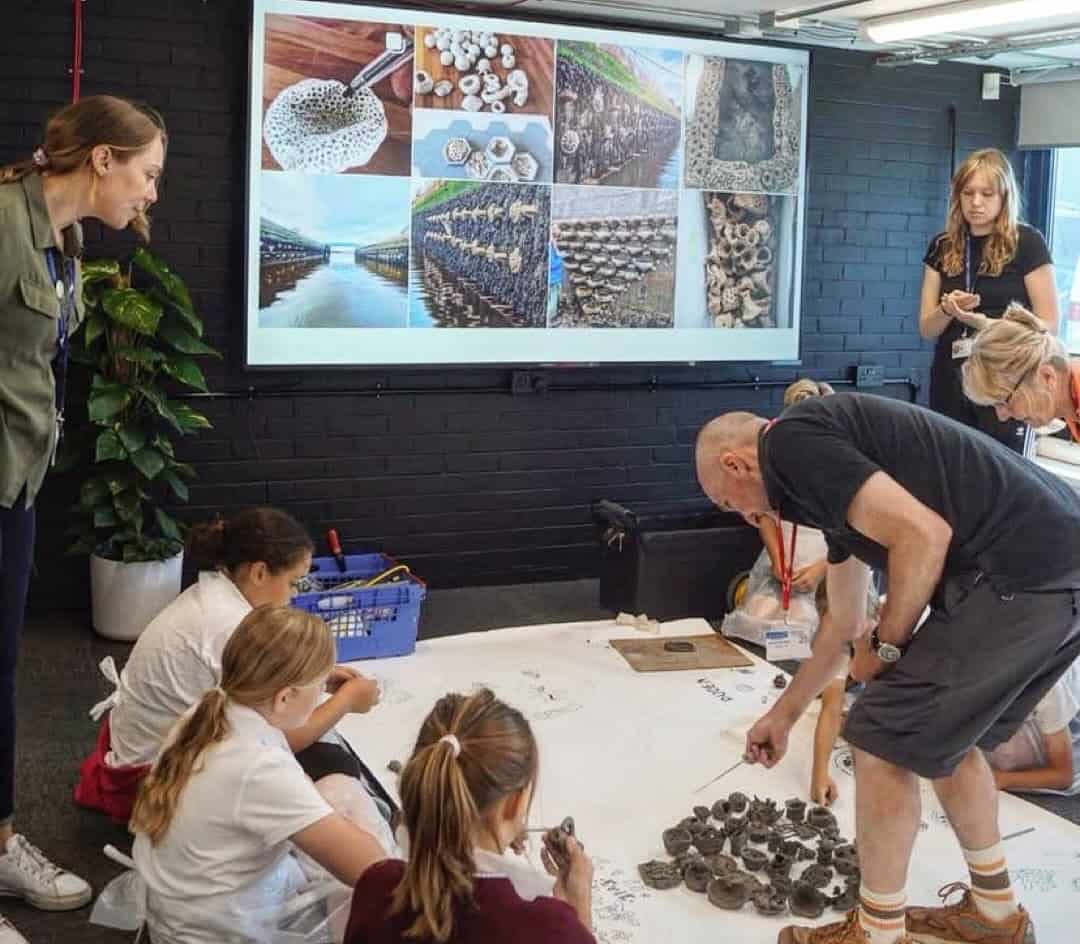
CoCreators include schools and local environmental projects across the South Coast, in Gosport and Portsmouth, as well as Yorkshire and Cumbria. Learning how to understand what marine wildlife wants and needs and being able to see the hands-on impact you have made, is all part of the CoCreate process.
University of Plymouth
This year, thanks to a research project by University of Plymouth Masters student, Claire Beckley, that real world success of the CoCreated pools in increasing biodiversity, or wildlife abundance and variety, has been recorded for the first time.
Claire, travelling from Canada to the Isle of Wight Biosphere (via Plymouth!) to work with Artecology on her research, first learnt how to make and install a set of ceramic inserts into new Vertipools at the studio in Sandown. Both the CoCreated and the simpler ‘control’ pools can be found at Artecology’s testbed, Science Beach. Here, over a period of four months, Claire monitored progress, tracking the colonisation of the structures by mobile marine species.

She explained,
“We discovered that even in such a short window, the ‘CoCreate’ Vertipools supported over three times as many individual mobile organisms, such as barnacles, compared to controls, with abundance significantly influenced by pool type and increasing over the study period.”
George: The process aligns closely with the NHS’s 5 Steps to Mental Wellbeing
Nigel George, lead at Artecology said,
“It’s been a pleasure hosting Claire and collaborating on this first CoCreate research paper with Plymouth.
“Scientific and policy response to our designs and to CoCreate shows that scaling is essential to future resilience in coastal communities around the world. Our Nature Inclusive Designs have been developed so that they can be made locally, anywhere in the world, without the need for special tools, materials, or dedicated facilities. Workshops can take place outdoors, in community spaces, or almost any place where people can gather and create together.
“The techniques bring much-needed life-cycle resources to any location where they are deployed. Artecology’s designs have consistently outperformed mass-produced eco-engineering alternatives. We know that the reason is simple: using hands-on making methods create unrivalled three-dimensional complexity in texture, pattern, and form. Instead of mass production, this is production by the masses!
“This complexity translates directly into bioreceptivity, the ability of a surface to attract, support, and sustain a wide range of organisms, from the first pioneering biofilm through to established plant and animal life. By maximising bioreceptivity, we create thriving, self-sustaining habitats that improve biodiversity from the ground up. This is all about supporting communities of wildlife.
“For us humans, the process aligns closely with the NHS’s 5 Steps to Mental Wellbeing, encouraging people to connect, be active, keep learning, give to others, and take notice. Storytelling, poetry, song and ceremony have all become part of the workshops, with people taking part weaving their knowledge, history and creativity into science-led conservation and engineering projects.”

Beckley: Underscores the role of community-driven initiatives
Claire Beckley’s research underscores the importance of this work in building community resilience,
“CoCreate objects, designed and installed with community involvement, not only enhanced habitat complexity, but also provided measurable ecological benefits.
“This underscores the role of community-driven initiatives in advancing practical biodiversity solutions in urbanised coastal environments.”
Together and with the simplest tools imaginable, we can challenge the norms of engineering and design worlds and transform the outlook for our intertidal zone. The power to make a difference for wildlife is literally in everyone’s hands.

Claire’s MSc thesis can be found on the website.
Assessing the Effects of Increased Heterogeneity on the Biodiversity of Artificial Tide Pools by Claire Beckley, University of Plymouth.
* A. Jones, Coastal Defences at Old Colwyn: Applying eco-engineering principles and lessons learned. Presentation delivered in Greening coastal infrastructure through eco-engineering – new CIRIA guidance. University of Portsmouth, 8th July 2025.
News shared by Claire from ARC on behalf of Artecology. Ed