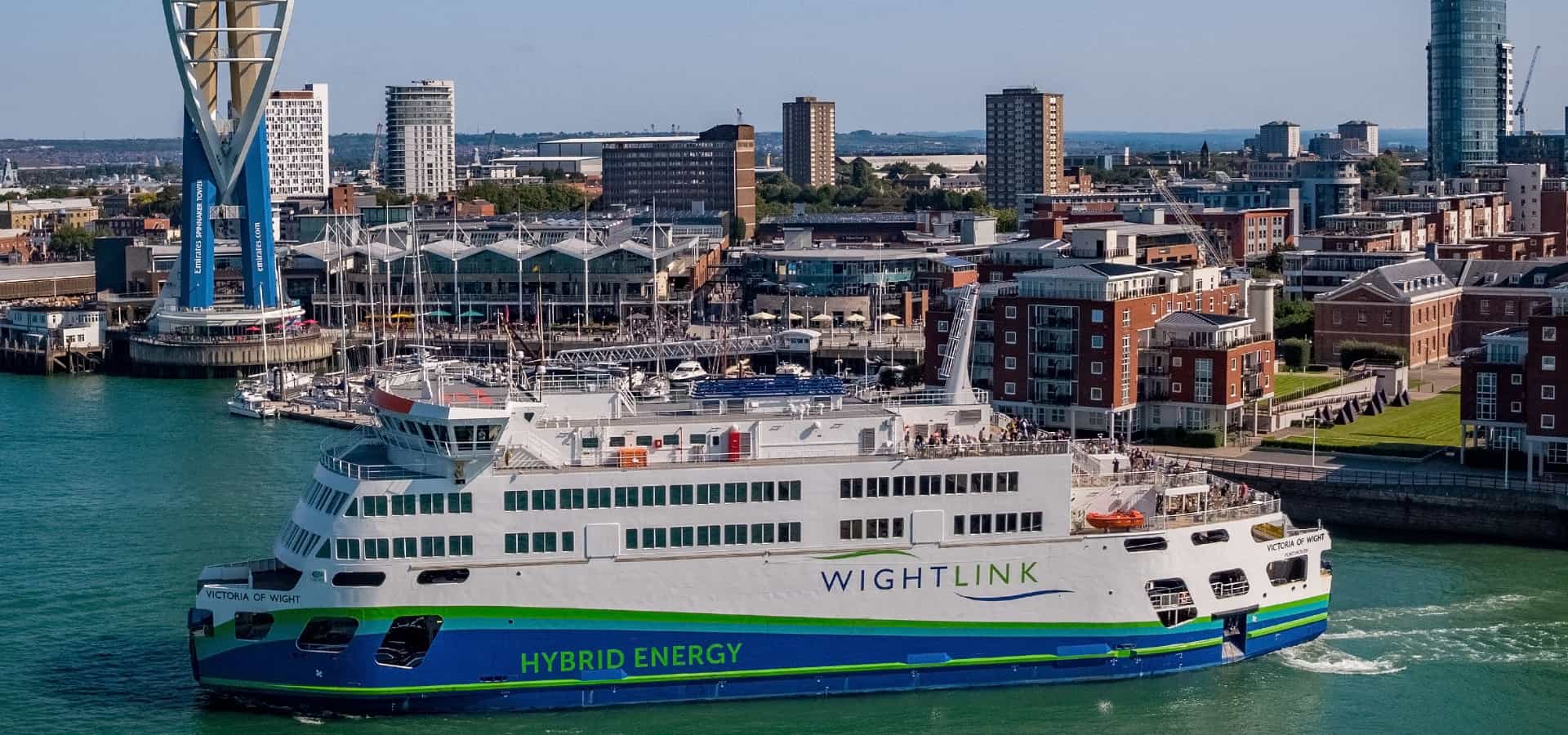
Isle of Wight ferry operator Wightlink has warned that the Government’s decision to extend the Emissions Trading Scheme (ETS) to the UK maritime sector could have damaging and unintended consequences – including increasing pollution rather than reducing it.
The new rules, due to come into force in summer 2026, will cost ferry operators like Wightlink up to £1 million a year, on top of recent National Insurance rises and higher business rates.
Threatens vital investment plans
This financial burden threatens vital investment plans, including Wightlink’s next-generation hybrid ferry, scheduled for order in 2026.
The UK ETS requires entities that exceed a certain emissions threshold to purchase allowances for each tonne of CO2 they emit. While operators are moving to decarbonise, without adequate electrical grid capacity upgrades, there is often no viable alternative, making UK ETS expansion detrimental to the ferry operators’ decarbonisation efforts.
A recent report from the British Ports Association found that 70% of UK ports are already at, or near, their ceiling in terms of available power. European ferry operators including P&O and DFDS have been forced to add an EU ETS surcharge to passenger tickets to cover the costs.
Operators will be incentivised to run smaller ferries
Under the proposed charging structure, operators will be incentivised to run smaller ferries – which produce higher emissions overall but are exempt from ETS – instead of larger, more environmentally friendly hybrid or electric vessels, which are heavier due to batteries on board.
This contradicts the government’s aims for the scheme: reducing emissions.
Scottish islands exempt
Despite repeated calls to re-consider, the government has not granted the Isle of Wight the same exemption as Scottish island services, even though Isle of Wight ferry links are a lifeline for residents.
In addition to Scotland’s exemption, Northern Ireland has also been granted a 50% reduction in UK ETS surcharges to align with the EU ETS, raising important questions about consistency and fairness in the scheme.
Taylor: Island communities will pay the price
Wightlink CEO Katy Taylor said,
“We’ve invested over £30 million in sustainable technology, yet we face an impossible challenge: there simply isn’t the grid capacity to make our services greener. Instead of supporting long-term emissions reductions, the current approach penalises operators like us without offering solutions.
“The ETS may aim to cut emissions, but in practice it risks doing the opposite and it will be Island communities who will pay the price.
“Wightlink remains firmly committed to sustainability and will not take any action that increases emissions but the Government’s current approach makes it more difficult for maritime companies to invest and risks undermining the UK’s green ambitions.”
Robertson: Our ferries are the very definition of a lifeline service
Conservative MP for Isle of Wight East, Joe Robertson, who has raised concerns in the House of Commons, said,
“It is highly disappointing that the Isle of Wight has not been granted an exemption from the upcoming UK ETS maritime expansion like Scottish Islands have. Yet again, the Government overlooks the Isle of Wight, and instead places further cost on our ferry travel.
“Ferries are our Island’s only connection to the mainland and are essential for accessing vital services such as the NHS and higher education. They are the very definition of a lifeline service and it is therefore incomprehensible that they have not been recognised as such, along with Scottish islands.
“This policy, imposed on us by the Government, offers no meaningful incentive for ferries to actually reduce emissions because there is insufficient grid capacity and instead risks imposing a green tax on Island life and our local economy. I have urged the Government to rethink this unfair decision and I will continue to raise it with Ministers”
Quigley: Concerned Isle of Wight has not been granted an exemption
Labour MP for Isle of Wight West, Richard Quigley, said,
“The UK ETS is a hugely important mechanism to reduce the UK’s carbon emissions across the economy. However, while I wholly support the Government’s ambitions for cleaner transport, I am concerned that the Isle of Wight has not been granted an exemption at this stage.
“Without adequate investment in local grid capacity, this policy makes the low-carbon transition for ferry operators incredibly difficult.
“I would welcome further consideration of how these measures can best reflect the unique circumstances of our Island community, and I look forward to working collaboratively with ministerial colleagues to ensure we reach a balanced and practical solution for everyone.”
News shared by Kelly on behalf of Wightlink. Ed